Category Archives: Family

Captain, My Captain

It is right and good, on Veterans Day, to honor all men and women who have served.  And so I do, sincerely.  But today my thoughts have been on one man: Captain Lawrence Edward Selden, USAF.  My father.

Dad went into the Air Force soon after my birth in 1956.  My first years were spent in simple and drab base housing in Greenville, MS.  Greenville was a flight training base.  As an Air Force doctor, Dad was tasked with treating everyone on the base, especially the many new pilots whose crash rate was high and whose injuries – if they lived – could be appalling.

After his service, Dad chose to move to a small town in a rural county in central Texas.  He spent the next 25 years caring for the poor, the sick, the injured, the dying.  When a patient could not pay, Dad took no payment. 

He was an old-fashioned family doctor.  Through all the years of my boyhood, he made housecalls at all hours of the night.  He missed holidays with us, missed workday and weekend nights at home, and missed more sleep than any one man should have to miss.  Even when sick himself, went to help those who were sicker when they needed him. 

In the most mundane ways, I am still shaped by his life.  To this day I don’t care to eat dinner until 7 p.m.; that’s when we ate when I was growing up, because Dad could rarely get home before then.  I can wake to phone calls in the middle of the night, then fall quickly back to sleep.

After my brothers and I left home, he moved to a remote and forsaken Indian reservation in northern Montana and helped the very poor and sick there.  When we were boys he often said he would do that someday, but we never believed him.  That was something else about Dad: he fulfilled his promises.

And when he grew tired of the raw Montana winters, he moved back to Texas to practice in a barrio clinic in San Antonio, caring for the indigent who had no place else to go.  He carried on into his 70s.  He finally enjoyed a few years of a simple retirement before dying on Christmas day, 2007.

If Dad ever complained, I never heard it.  If he ever flagged, I never saw it.  If he ever wavered in his commitment to others who needed him…well, he simply never did.  Having grown up desperately poor himself, he gave his life to caring for those whose troubles and want he knew all too well.

A strong man, he gave his strength to help the weak.  A kind man, he ministered to those whose lives knew little of kindness.  A man with a gift for healing, he healed others.

If I had to craft a description of an honorable soldier, that would be it.

Come this Christmas morning, twelve years will have passed since he did.  I miss him, terribly sometimes, achingly.  I still dream of him, and once or twice a year I wake in the middle of the night, thinking I’ve heard his voice and his steps through the house as he leaves in the darkness to help someone who needs him.

So tonight, Dad – my namesake, my father, my hero – I salute and honor you, the most honorable man I have ever known.
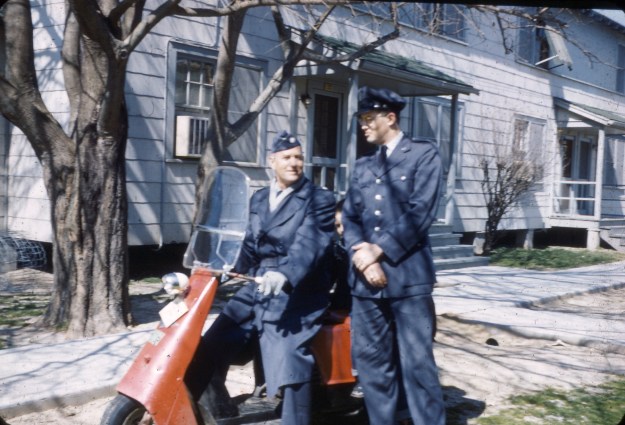
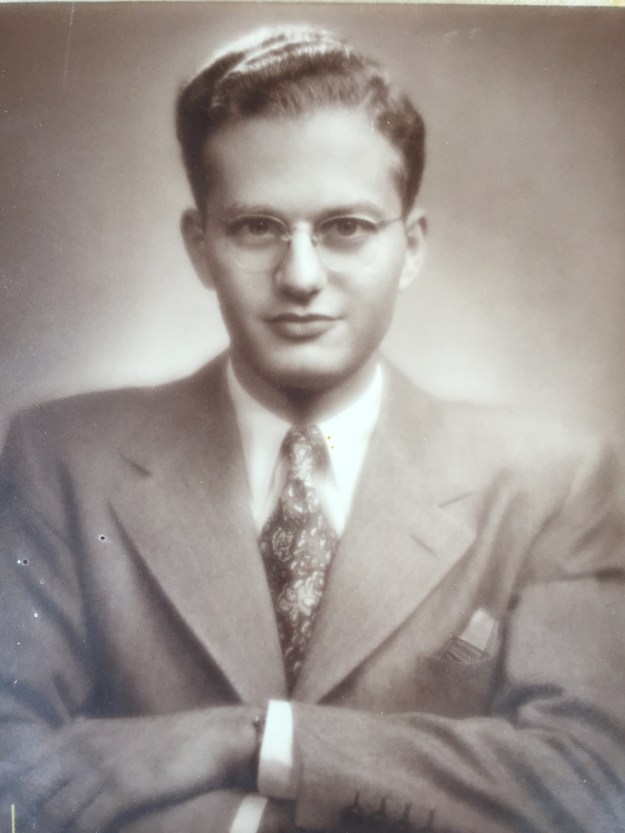
Larry in Capt. uniform w Col. Thaxton on scooter

My father (standing), Greenville, MS, 1957

For My Father

In late November, 1985, after 30 years of marriage and life in a small Texas town, my father left my mother and all the friends and family he had in the world.  In a move that bewildered all who knew him, he struck out alone for the northern reaches of Montana.  One must have known him then to understand how wildly radical this move was for him.

My father was not an adventurous man.  He was a man of roots and routine.  Like many poor children of the Depression – he and his two brothers slept every night of their boyhood on cots in the screened porch of the tiny house his parents rented in Palestine, Texas, because so many extended family had taken refuge in their two bedroom, one bath house – he sought security in work, family and community.  He never ventured beyond east Texas until his service in the Air Force, and later for a few days each summer when we took camping trips to Colorado.

That he could deracinate himself from all that he knew was incomprehensible.  By means I still don’t know, he was hired by the Bureau of Indian Affairs to manage the health clinic at the Rocky Boy’s Agency near Box Elder, Montana, a Chippewa Cree reservation about 30 miles south of our border with Canada.  As we say here in Texas, if it wasn’t exactly nowhere, you could see nowhere from there.

Rocky Boy Land

Bear Paw Mountains and plains on the Rocky Boy reservation

This man who for three decades shaved every morning before donning a tie and button-down shirt, and had never seen more than a few inches of rare short-lived Texas snow, drove to the Montana plains in a 2-wheel drive Buick (a blizzard in northern Wyoming left him stranded in his car for more than a day), adopted clothing worthy of Jim Bridger, and grew a thick dark beard.

I didn’t speak to my father for almost two years after he left my mother.  That was the only time in his life that I knew him to behave dishonorably.  Mom was devastated; her sons were angry.  Though we had all long since left home and begun making lives of our own, my brothers and I were ripped from the home and family that still rooted us.

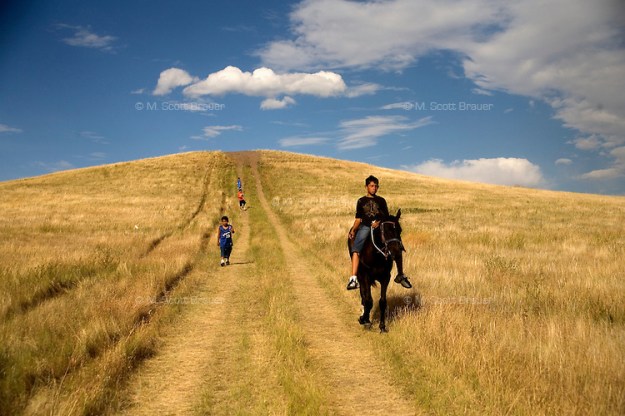
boy on horse

Indian boys at the Rocky Boy’s Agency

But I still loved my father.  So in May, 1987, I went to see him, to try to understand why he had left us, and to learn about his new life.  From our drive under the indescribable concave Montana sky to the reservation from the Great Falls airport, through a week at the agency, and the meandering three-day road trip back to Texas (where he had business for a few days), I learned more about my father than I had in all my life before that time.

I never learned why he left my mother and the life he worked so hard to build – and I never completely forgave him for it – but I came to understand why he sought a new life in a strange world, and why he came to love a tribe and people incomprehensibly different from any he had known before, a love and admiration he kept to the day he died.

rocky-boy-powwow-03-850x567

Annual dance ceremony at the Rocky Boy’s Agency

I have lost every palpable thing from that time – photos, journal, trinkets picked up along the way – gone with the old house in hurricane Ike in 2008.  All that is left are memories as faded as an old photograph and fading still more with every year: walking the silent, green Bear Paw mountains, unchanged for ages; the lonesome winds blowing through the lonely village of Box Elder; the vast expanse of the Montana plains; a haunting visit to the Little Bighorn battlefield; throwing snowballs at each other at the top of Raton Pass after a spring snowstorm.

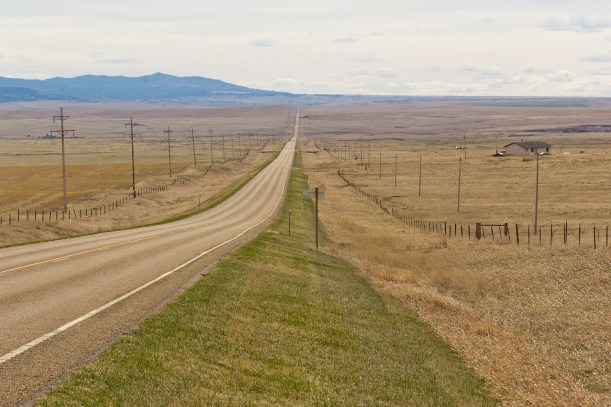
road east from agency

Highway leading east of the reservation, the start of our road trip

I don’t think of these things often any more.  They came back to me today when I began reading again a book my father gave me on that trip: Son of the Morning Star, by Evan S. Connell.  I was lead back to that book by way of an aimless succession of books about American Indians.  Memories of my father came back with it.

So tonight I toast my father with the best whisky I have on hand (though I also never understood his fondness for cheap blended Scotch) and with a sadness that caught me by surprise.  We lost each other once, then met again.  Through a long meandering drive through the high plains of Montana and the western mountains, we discovered that we were different men than we had ever known.  And we learned again that we loved each other.


Tribute to a grand man

Growing up, I was blessed with a great-uncle named Alan Meyer.  No relation – the surname rather gives that away.  But we called him Uncle Alan and loved him very much.  He could scarcely have been more different from my family and boyhood life: he was cosmopolitan, a graduate of Yale, a successful advertising executive in New York and Dallas, dressed with a sartorial elegance quite strange to us, and he was Jewish.

He was the life-long companion – ‘significant other’ we would say today – of my blood great-uncle, Harry Sivia, brother of my paternal grandmother, and a fine man in his own right.

To my parents’ credit, they were the first to welcome uncles Alan and Harry into our extended family, in the early 1960s, as a same-sex couple, with a warmth and sincerity fully equal to the love and hospitality they offered to everyone else.  To my brothers and I, Alan was no less a part of our family than anyone else who sat at our holiday meal tables and drank whisky and told tales with the other Selden men on the porch on pleasant evenings.

Jewish?  Gay?  We little understood what those meant, and cared even less.  Uncle Alan was our ideal of a gentleman (we loved Harry, too, but brilliant though he was, he was a curmudgeon).  I can only wish to possess half the wit, innate kindness and grace of my uncle Alan.

Today I  finally got around to examining a few of Alan’s personal effects that were left to me after his death.  I found a small book of poems that he and a friend published in April, 1945, while Alan was still serving in the U.S. Army.  He never spoke of the book, and no one in my family knew of it or that he had written poems in his youth.

In his honor, I’ll share of few of the poems here.  The first poem in the book helps me understand how this most gentle man could choose to serve in a violent conflict.  Like the rest of the family which adopted him and loved him as one of us, he was dedicated to “the neverdying struggle to be free.”

THE CAUSE FOR WHICH WE FIGHT

(To My Parents)

If it come to that and in the service                                                                                                Of the cause for which we fight I shall indeed                                                                             Be called to sacrifice my life,                                                                                                              I pray That you will hear these things:

I realize my gift cannot compare                                                                                                    To yours who gave an only son you loved                                                                        (However little merited that love).                                                                                                My gift was negative – I ceased to be,                                                                                          And by that action made my life a whole;                                                                                    But yours was positive: you lost what was.

I loved and honored you above all else,                                                                                      And yet I have not honored you enough,                                                                                  Who built me, made me fit to serve – and loved.                                                                      This do I know, and this do I regret –                                                                                            But anguish nor remorse remake the past!

Know you that fact; I’m gone and that is all;                                                                                Be proud you gave whom country could employ                                                                            In her behalf when she had need of men.                                                                                     Of this you may be sure:                                                                                                                     I served my country and my countrymen –                                                                                 And well I served the cause for which we fight:                                                                           The neverdying struggle to be free.

(AHM, Ft. Monmouth, N.J., Feb., 1943)

Tall Cotton Back Home

Spring rains have left the ranch bursting with green.  Cows, horses and donkeys are fat and happy, which leaves Papa Gil and Murr happy, too.  Pasture floods had receded just enough last weekend to move a few cattle and do a bit of work.  ‘Feast or famine’ is often the rule for Texas ranchers; we enjoy times of plenty when God grants them.

A Little Slice of Heaven

That’s how I feel when I visit my parents back home, at their ranch near New Baden, Texas. Spring brought rain and mild weather; the land is lush and green, and young life is everywhere to be seen: calves, foals, goslings, etc.

After a long day working in the pastures, we enjoyed our favorite escape: Saturday night at the 110-year-old New Baden General Store, where they grill freshly cut rib-eye steaks that deserve their own poems.  Here is a little taste, figuratively speaking:

Ella’s Baptism – on tape!

Photos of Ella’s baptism (below) are wonderful, but the videos, of her and Pastor Rush during the ceremony, and family before and after, is even better.

Error
This video doesn’t exist

Dancing Cora

Niece Cora performed in dance recitals today, ballet and jazz forms.  I can’t believe how tall, stately and graceful she has grown.  She’s also warm, funny and intelligent beyond her years, with a diversity of interests that impresses me (she is also the most avid equestrian in the family).  Countless hours of training and practice went into her performance.  I am very proud of her.

Mother’s Day Gift

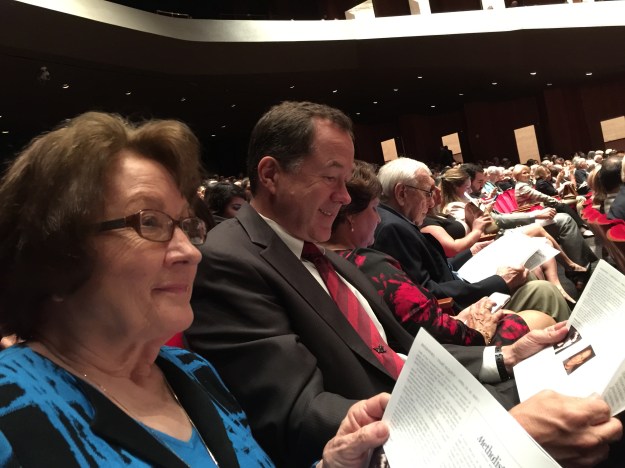
Mom, brother Kevin, and sister-in-law Lisa at Jones Hall in Houston, for a recent performance of Faure’s Requiem by the Houston Symphony and chorus.  A few years ago, Mom played organ accompaniment for a performance of this requiem, sung by a large regional choir in Bryan. She loves the piece.  I like to see her happy.

IMG_2177