For no reason except to share and to remember. November scenes from my little corner of the bay…
(NOTE: the last and best photo, of an osprey with a fish in its talons, was taken by friend and neighbor Chris Kuhlman.)

For no reason except to share and to remember. November scenes from my little corner of the bay…
(NOTE: the last and best photo, of an osprey with a fish in its talons, was taken by friend and neighbor Chris Kuhlman.)
A pair of Spotted Sandpipers woke me this morning. Not from sleep – such tiny, quiet things aren’t up to that – but from a conscious, insentient slumber. After 24 years living by Galveston Bay, I sometimes get distracted by the tedious and drab routine of chores and schedules, such that I neglect the quiet and unassuming beauty that surrounds me every day. Shame on me for that.
Stepping outside this morning with a cup of coffee, I saw the two birds bobbing among the rip-rap, hunting for breakfast. They are small – just over 7 inches – and subdued in color, making them easy to overlook, especially against the grand palette of the bay and the multitude of larger, showier birds.
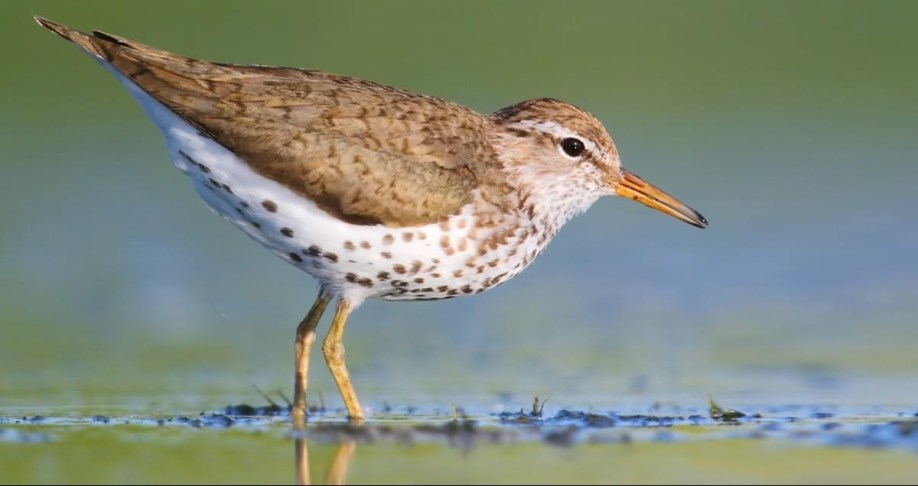
Actitus Macularius
But one behavior always catches my eye: they bob their tails up and down. Nobody knows why. Spotted chicks start bobbing soon after hatching and carry on for the rest of their life. Ornithologists call this “teetering.” Indeed, when they really get into the swing of it their whole body teeters from bow to stern, like a tiny feathered see-saw.
Nicknames are sure to follow such odd behavior. A few of them: teeter-snipe; tip-tail; teeter-peep. My favorite is “teeter-bob.” I didn’t make any of those up.
So where was I? Oh yes: morning; coffee; a mind already distracted by the tasks lined up for the day. And a pair of teeter-bobs….
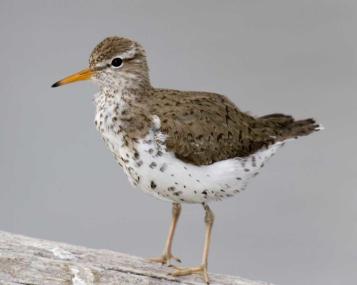
As soon as I saw them, the engine of my day, already accelerating, sputtered and went off the rails. Forgetting the chores that were bedeviling me even before I had woken, I retrieved a camera and began taking photos of my teeter-bob neighbors (photo/video montage below). Which lead me to notice the clear water, wide beach and low tide that follow the first fall north winds. Which in turn alerted me to the soft, polished marble surface of the bay on a rare windless morning. And then an osprey whistled in the sky, a pandemonium of parakeets dramatically announced their arrival at my bird feeders, and the dawn haze vanished to reveal ships moving in the channel and small sailboats searching for a breeze.
For the rest of the day my gaze and my attention turned bay-ward. As it does every day here, light, shade and colors modulated minute by minute; waterfowl zigzagged across the horizon or floated by; sailboats raised sails, their colors catching fire in the sunlight as they tacked, then darkening as they jibed.
Tonight, thinking back over the day, I fret over the tasks left undone on a day when they really needed doing. But I can’t bring myself to regret it. Today I let myself once again be enchanted by the wonders that first brought me here and which have kept me here for more than a third of my life.
Today I was happy. I was – as much as I can be these days – carefree. And I owe that to a lowly pair of teeter-bobs. Thank you, dear little friends.
One of the joys on Galveston Bay at the onset of fall and the coming of winter is the arrival of great numbers of migratory waterfowl. They augment our already numerous resident birds, so that, to the careful observer, our days are alive with many species flying, floating and perching anywhere the eye may look.
Our dominant southerly winds abate, also, and with the occasional north wind our tides are lower. This leaves more beach exposed next to my house, drawing wading birds in. Just yesterday three sandpipers were feeding there. (See video below.)
(If you are a fan of collective nouns, as I am, you know that none are more colorful and quirky than those given to birds. A group of sandpipers is…a fling!)
This afternoon, attending a Veteran’s Day ceremony with neighbor Chris, we spotted what we thought was a raft of ducks, but when he zoomed in on them with his magnificent camera (Chris is a profoundly talented professional photographer) we saw that it was a raft of a dozen or so Hooded Mergansers – the first I have seen here.
And above them flew an osprey with a large fish in its talons. Chris captured a sequence of brilliant photos of it as it flew over us.
A few times this past week I have spotted a pair of kingfishers on my pier; this is a rare blessing, since they usually prefer more protected water.
May I never take these blessings for granted. May their memories never fade from me.
William Cullen Bryant wrote a worthy poem on the subject:
To a Waterfowl
Whither, ‘midst falling dew,
While glow the heavens with the last steps of day,
Far, through their rosy depths, dost thou pursue
Thy solitary way?
Vainly the fowler’s eye
Might mark thy distant flight, to do thee wrong,
As, darkly seen against the crimson sky,
Thy figure floats along.
Seek’st thou the plashy brink
Of weedy lake, or marge of river wide,
Or where the rocking billows rise and sink
On the chaféd ocean side?
There is a Power, whose care
Teaches thy way along that pathless coast,—
The desert and illimitable air
Lone wandering, but not lost.
All day thy wings have fanned,
At that far height, the cold thin atmosphere;
Yet stoop not, weary, to the welcome land,
Though the dark night is near.
And soon that toil shall end,
Soon shalt thou find a summer home, and rest,
And scream among thy fellows; reeds shall bend,
Soon, o’er thy sheltered nest.
Thou’rt gone, the abyss of heaven
Hath swallowed up thy form, yet, on my heart
Deeply hath sunk the lesson thou hast given,
And shall not soon depart.
He, who, from zone to zone,
Guides through the boundless sky thy certain flight,
In the long way that I must trace alone,
Will lead my steps aright.
Our coots are home! At dawn today I saw the first large raft of coots of the fall. They are back for the winter, and I welcome them with a happy spirit.
Of the vast diversity of birds here, migratory or resident, none is more plain or humble. Neighbors and I will spend weeks in fall anticipating the return of the grand white pelicans, but we never speak of coots. But I like them very much; they are my kind of bird: common, unpretentious, simple. The pelicans dazzle me, but I feel at home with coots.
That thought occurred to me several years ago when it was time to write my annual Christmas letter. Our coots seemed a fitting subject for the season. So I thought I would share that letter. My feelings about our plain friends hasn’t changed.
Christmas, 2011
Dear Friends,
“What a crazy old heron.” “He’s a mean old sandpiper.” “You’re turning into a crusty old roseate spoonbill.”
None of those sentences really makes sense, do they? (The last one is just silly – I just like to use the name ‘roseate spoonbill’ whenever I can.) But call someone an “old coot” and there’s no mistaking what is meant: mean-spirited, misanthropic, intemperate…even downright ornery.
No one knows the origins of the phrase. Why choose coots to describe ornery people? Perhaps because they could not be less flashy or attractive; no less inspiring bird exists. The American Coot is one of the most common waterfowl in all of North American: found in 50 states, sometimes in ‘rafts’ of 1500 birds; plain in appearance; awkward in flight and walk (“spalatterer” is one nickname for the coot, for their ungraceful attempts to rise into flight). One observer bluntly describes them as “unloved and unlovely aquatic birds…a truly ugly and awkward bird, and virtually inedible to most people.” (Though Cajuns, who call them ‘poule d’eau’ – water chickens – are known to include them in gumbo.)
Perhaps the name itself suits a pejorative. Clipped and crude in its monosyllabic, Anglo-Saxon earthiness, ‘coot’ does not ring with music or rhythm. Other aquatic birds similar in size and habits bear names that would fit just fine in a poem by Keats or Wordsworth: Golden Plover, Avocet, Little Curlew, Red Phalarope. The Romantic poets never wrote an “Ode to a Coot.”
Nor are they musical themselves. Ornithologist John Tveten, author of “Birds of Texas,” describes coot calls as “a variety of clucks, cackles, grunts, and other harsh notes, some rather eerie.”
Is there any wonder then, that, if we must use a bird to describe dotty or mean people, we would settle on the coot? There seems to be little about the species to recommend it for any higher purpose.
But I really must object. For all their Quaker plainness and cackling grunts, I love these little birds. They are daily winter companions, bobbing along the shore with a constancy more true than any other bird. Like old chairs, they fill space with familiar comfort, but don’t distract us from all the more important things we clutter our lives with. They endear themselves to me by their simple faithful presence.
They are tolerant of humans, even open to friendship with us. I’ve read many accounts of bonds formed between coots and people. A woman in San Diego where, as here, coots migrate in winter, writes of a years-long friendship with coots:
“I keep Cheezit crackers in my pocket and give the coots a few crumbs. If you hand feed them every day so that they can clearly see your face, coots will form lifelong bonds with people. It is always gratifying to have old friends come running up to me in the fall when I haven’t seen them for six months.”
Others note that coots recognize individual human faces, and they readily ‘flock up’ with people for safety and companionship, as they will do with almost any species that will tolerate them.
And lastly, though certainly not least of all, the plain old coot was among the first birds to return with us to our scarred shores after the hurricane that battered our town three years ago. Through that first dark winter of recovery, they were with us every day, small feathered tidings of comfort and joy.
And still more than that: they offer a chance to test our capacity for mercy. For all our crassness and knavery, every kind human heart reserves one of its best rooms for all the ugly, bumbling, humble creatures that fill our world – those who will never glide untroubled through the world thanks to the random gifts of beauty, grace or song. I don’t hold my breath when I see coots, but I always smile.
We love coots with a sincerity we can’t quite muster for their more lovely, blessed kin. That we do so is rare evidence that some residual of God still breathes in the human spirit. If coots could ponder such things, I believe they would be grateful that, rather than being admired, they are loved.
So from this old coot to you, best wishes for a joyous Christmas.

Fulica americana, the American Coot
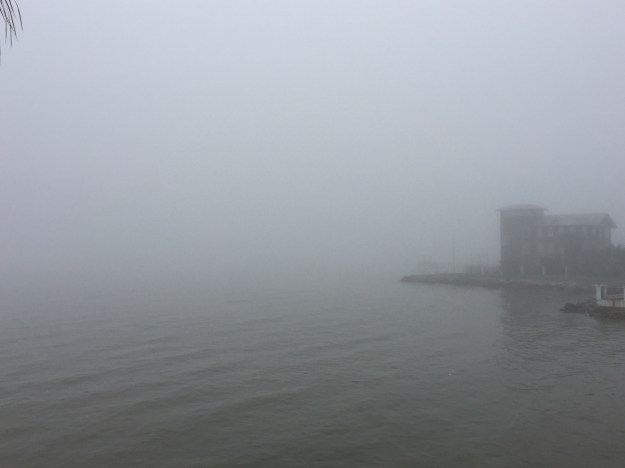
From clear to thick sea fog, in less than ten minutes:
“And when my mind is wandering
There I will go
And it really doesn’t matter if I’m wrong I’m right”
I had the best of intentions to spend this evening revising and polishing a business proposal due Tuesday. All day, while puttering around on small tasks, I worked over the specifications and pitch in my mind and settled how best to arrange the final structure.
But, as they are wont to do, a bird set my mind to wandering…
(Wont. Now there is a word to cherish and resurrect. As with most words which give English its clear and plain monosyllabic power, it stretches back to our Sanskrit roots, through the Old High German.)
Tonight, through a quiet fog that has shrouded the bay all day, I heard a sound I haven’t heard in 14 years: the call of a loon. You might think this unremarkable; after all, Galveston Bay is wildly profligate with birds, most of all during winter, when dozens of species migrate here for our mild weather, adding to the ubiquitous abundance of our resident birds.
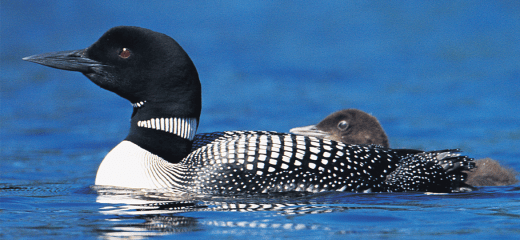
The Common Loon winters on our bay. Nothing unusual about that; photographers capture them each year. But according to Audubon, it goes silent during winter. While here, experts say, it withholds the lonesome, haunting call – never forgotten, once heard – for which it is famous. But loons, like all wild creatures (I count myself among them) pay no heed to “experts;” to my great delight, they sometimes defy categories and absolutes that we try to place them in.
Their call is so beautiful, plaintive and distinctive that it can’t be mistaken for the call of any other bird. I first heard it on a cold December night in 2004 (copied below); it surprised and moved me so deeply then that I wrote a poem and send it around for Christmas. Through the years and winters since I have not heard it again until tonight. It’s power to move me has not waned: my heart seems to stop, and I forget to breath.
All that seemed important before that sound now falls away; tomorrow will suit other matters just fine. I may never again hear a loon call on a foggy night. For this one night, I will let that blessing linger and abide unblemished by grubby distractions.
Through 62 years I have adventured across 48 states and many countries, but if there is greater joy than thinking quietly across the hours of a still, foggy evening on a saltwater bay, from which loons call through the mist, while ten cats wander on and off my lap, sipping a fine Scotch whisky (a smoky Ardbeg) to the music of Verdi…well, I haven’t found it.
A Yodel of Infinite Variation
Resplendent in summer, the common loon loses all
its color in fall, arriving on our southern coast wearing
only brown and grey, colors befitting an unremarkable figure:
“stout, heavy-headed, short neck.” Even in name –
from the Swedish for “blackened ashes of a fire” –
the loon is our most unlovely winter guest.
In all but voice, the loon excels at being plain.
In long summer days, the loon sings in voices
so numerous they are defined in human terms:
tremolo (“the loon’s laughter”), the wail, the call,
and – inspiring poetry from Audubon – the yodel
“of infinite variations, repeated, rising and undulating.”
Ancient Scots called the loon the “calls-up-a-storm,”
believing its wild trill shook weather from the sky.
Through the winter, the loon goes silent, as if
in mourning for the long bright days of love
and tall green reeds plump with seed. Exiled
from summer, the loon withholds its polyglot display.
In nine years on this coast I have never heard a loon call
or wail or yodel. But three nights ago, on the first cold night of winter,
a single loon sang out from the dark waters of our bay,
a lonely keen that broke the silence of the stars
and troubled the thoughtless habits of my mind.
And nothing since has been the same. The world still spins
in perfect indifference to me, to all my ambitions
and follies. The days still stumble over each other
without sense. I still grieve each evening for the kind words
I did not speak, the easy mercies left undone.
But I am lifted now by the lightness of an undeserved blessing.
A loon sang to me when all the ornithologists say
it would not. And we can still sing out across
the long winters, across the dark waters to the lights
on the far shore, not knowing if our voices will be heard
but singing out anyway, crazy as loons, raising the song
of our own infinite variations of grace.
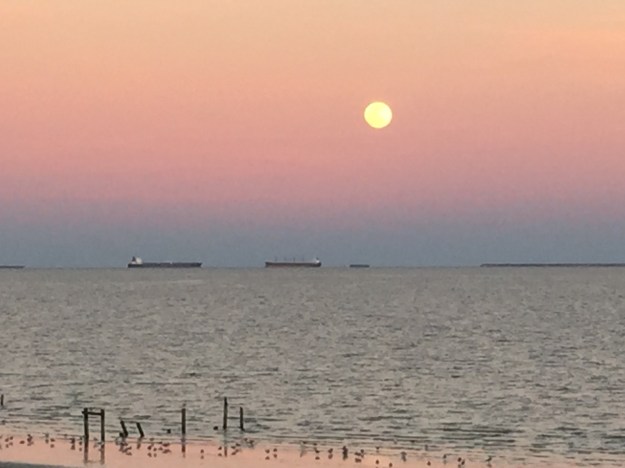
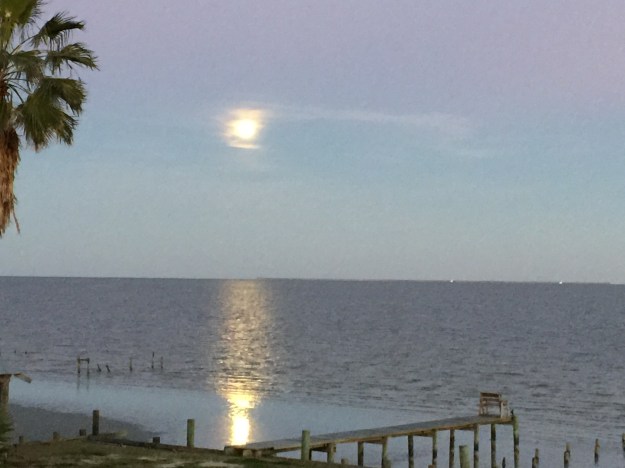
The January full moon, which eclipsed fully, was astonishingly beautiful. I captured these photos soon after its rise, while ships were passing in the channel and the dusky horizon was brushed in pastels.
One cannot live on this bay for 23 years, with eyes open, and not feel awed by the unrestrained flourish and fecundity of birds. In my small world, they furnish the motion and sound that dominate each day. In other words…life.
I have made a hobby of knowing them. I watch them, study them, listen to them. A shelf in my house holds nothing but books about birds, all well used. I know our birds by sight, by silhouette, by flight pattern, by time and place, by behavior, by song. I know our residents, and I know those who only visit or migrate here to spend winters. I treasure each species, each bird, and each time I learn something new about them I treasure them more. In my relations with birds, familiarity breeds affection, and I know and love them well.
But they can still humble me. Just tonight, as I stepped out to the deck to sip a bit of Scotch and to watch lightning far to the east, I heard a bird I have not heard before. A single, clear, brief note, falling and echoing faintly at its end, sounded above the shore. It continued again and again, so that I could hear the bird rising in the air over the bay, then dropping and moving over my yard before soaring again over the water.
I was entranced. This was a bird call like no other I’ve heard before. The night is very dark, no moon lightening a sky shrouded by storm clouds. I got no glimpse of the bird itself.
What was it? I have no idea. Perhaps I never will. I haven’t heard it before in all these years; perhaps I’ll never hear it again. It will trouble and perplex me – I really want to know this new bird that courses through my world so late at night.
I’ll have to live instead with an intriguing mystery.
In November, 2000, a month after moving here, I planted two Canary Island date palms in the bare space between the house and the bay. Less than two feet tall at the time, they had grown from seeds I collected from the best trees I could find. I selected these two from a few dozen I tended in pots in the garage. They were to be the tropical showcase of the bay-front yard.
I took great care with them, and they flourished. They grow slowly, as is their nature, but within a few years they were displaying all the traits I admire in the Canary: sturdy trunks; long arcing leaves; a broad canopy unequaled among palms. They shaded my cats and me through summer afternoons, and sheltered birds innumerable, especially the flocks of monk parakeets that seem born to pair with such a tree.
Over these 18 years they have endured the extremes of weather the Texas coast is known for: fierce storms, heat and drought, even the rare freeze and ice. Returning after hurricane Ike in 2008 I found my house and all that I owned wiped from the face of the earth, but the date palms stood; though a bit worse for wear, they survived that storm’s 17-foot storm surge and 110 mile-per-hour winds. Through storms and calm, I marveled at how they can be both durable and delicate.
But they won’t survive a bacteria so rudimentary that it has no cell wall and cannot be cultured. The Texas Phoenix Palm Decline phytoplasma, tiny as it is, will do what even the ferocity of Ike could not do: kill my old friends.
The largest is dead now. As is typical with TPPD, its lowest leaves browned and died; those above soon followed. Nothing green remains on it now, only a handful of dead leaves I haven’t yet removed. The other palm still displays a crown of new green leaves, but its lower leaves are browning and dying, showing the certain early stages that will take the tree before summer is gone.
It breaks my heart to see them now. Yes, they are only trees. But their roots were put down here when mine were. Their tropical grace has framed my view of the bay through changing light and seasons, through countless rises of sun and moon, through bay storms and blue skies. They have cheered and soothed me through my own storms and frosts.
I cannot imagine this place without them. When they are gone, they will leave empty places in the landscape, and in my heart.
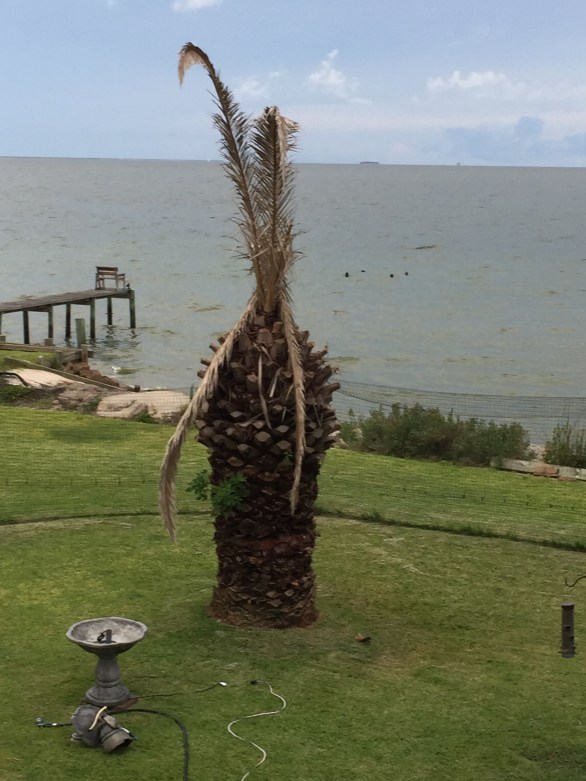
The largest, now dead
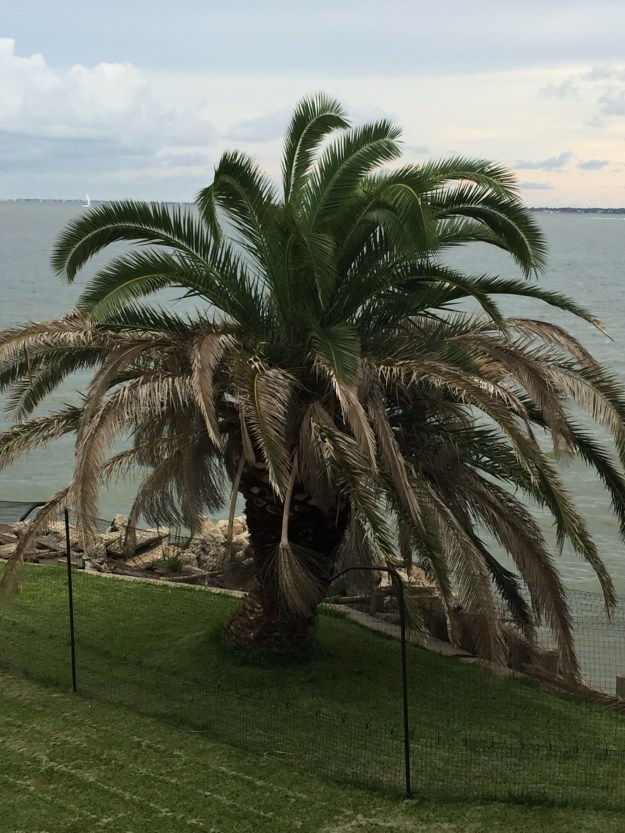
The smaller, showing TPPD symptoms
On the winds of our first Gulf storm of the season arrived the Hurricane Bird. I spotted six of them soaring high over my house at dawn. Word spread quickly along the shore; before 0800 neighbors Chris and Jessica texted to say they had counted 18.
We haven’t seen them since August of last year, when they arrived with another storm, hurricane Harvey. We’ve seen them during other storms in my years on the bay – Ike, Rita, Alison – as I’m sure they’ve been seen during storms since the Karankawas first wandered to this coast. As with those storms, they will be gone when the winds calm. They are pelagic by nature, and the open sea draws them away.
Hurricane Bird is just a nickname, known today mostly only by old-timers like me. Their true name – and no bird more deserves such a grand name – is Magnificent Frigatebird.
Frigate, because they “can take food directly from the bill of another bird in an aerial battle. Because of their swift, soaring flight and marauding behavior, Magnificent Frigatebirds were named after British frigate warships.”
Magnificent, because…well, because they simply are.
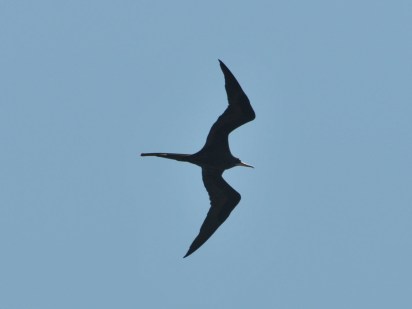
If you’ve seen one, you understand. They are so beautiful and distinctive that the Texas Pelagics birding group, which for all other species identifies other birds with similar characteristics, says they have, in effect, no equal: “Similar Species: With long sharp-angled black wings and long forked tail, Magnificent Frigatebird is unmistakable.”
Houston Audubon makes similar praise: “the Magnificent Frigatebird is instantly recognizable even at long distances. The bird has a 7.5 foot wingspan; relative to its body weight, the Magnificent Frigatebird has the largest wing surface area of any bird alive.”
They are masterpieces of flight. They can glide and soar for up to two months without setting down; rise to a height of 2.5 miles; glide for 35 miles without beating a wing. They sleep on the wing, sometimes for periods as brief as ten seconds and always while they are rising to gain altitude.
Pelagic they certainly are, but they are not birds of the water. For a creature that spends most of its life over the open ocean, water can kill them. Their feathers are not waterproof. They fly almost without cease because “they couldn’t take a break even if they wanted to; unlike most other seabirds, frigatebirds can’t swim, becoming waterlogged and eventually drowning if they do encounter water.”
They are visitors only here on Galveston Bay. But while they are with us, they fill us shoreliners with excitement and joy. We don’t know when they will arrive; we don’t know how long they will stay; we don’t know when they will leave. In this, they are like grace.
But while they are here, may they find welcome and rest. Like old friends long unseen, I hope they stick around for a while.
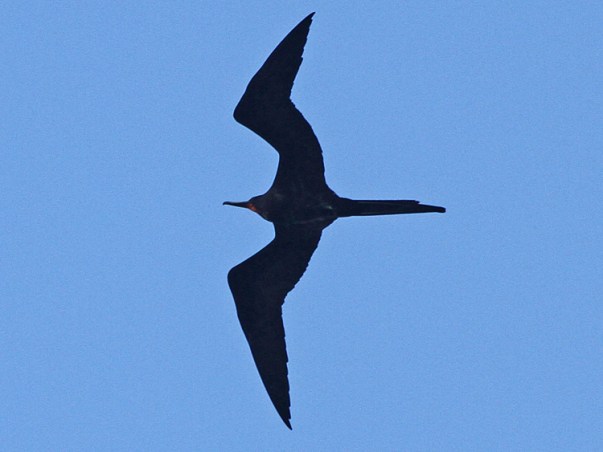
(There are more beautiful photos of the frigatebird, but this aspect, like a silhouette high above us, is almost the only way we ever see it, and is how we know it.)
 tejaslibertas