Author Archives: Eddie Selden

For My Father

In late November, 1985, after 30 years of marriage and life in a small Texas town, my father left my mother and all the friends and family he had in the world.  In a move that bewildered all who knew him, he struck out alone for the northern reaches of Montana.  One must have known him then to understand how wildly radical this move was for him.

My father was not an adventurous man.  He was a man of roots and routine.  Like many poor children of the Depression – he and his two brothers slept every night of their boyhood on cots in the screened porch of the tiny house his parents rented in Palestine, Texas, because so many extended family had taken refuge in their two bedroom, one bath house – he sought security in work, family and community.  He never ventured beyond east Texas until his service in the Air Force, and later for a few days each summer when we took camping trips to Colorado.

That he could deracinate himself from all that he knew was incomprehensible.  By means I still don’t know, he was hired by the Bureau of Indian Affairs to manage the health clinic at the Rocky Boy’s Agency near Box Elder, Montana, a Chippewa Cree reservation about 30 miles south of our border with Canada.  As we say here in Texas, if it wasn’t exactly nowhere, you could see nowhere from there.

Rocky Boy Land

Bear Paw Mountains and plains on the Rocky Boy reservation

This man who for three decades shaved every morning before donning a tie and button-down shirt, and had never seen more than a few inches of rare short-lived Texas snow, drove to the Montana plains in a 2-wheel drive Buick (a blizzard in northern Wyoming left him stranded in his car for more than a day), adopted clothing worthy of Jim Bridger, and grew a thick dark beard.

I didn’t speak to my father for almost two years after he left my mother.  That was the only time in his life that I knew him to behave dishonorably.  Mom was devastated; her sons were angry.  Though we had all long since left home and begun making lives of our own, my brothers and I were ripped from the home and family that still rooted us.
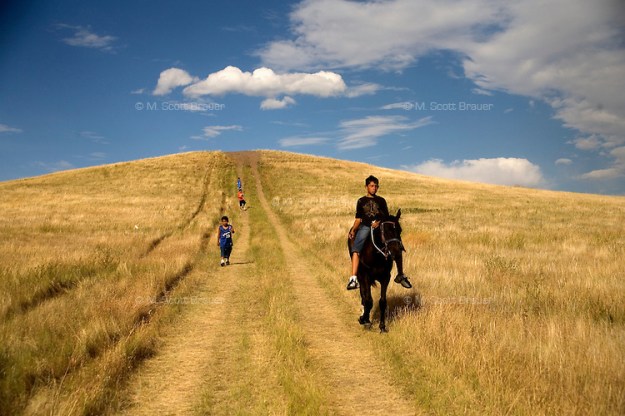
boy on horse

Indian boys at the Rocky Boy’s Agency

But I still loved my father.  So in May, 1987, I went to see him, to try to understand why he had left us, and to learn about his new life.  From our drive under the indescribable concave Montana sky to the reservation from the Great Falls airport, through a week at the agency, and the meandering three-day road trip back to Texas (where he had business for a few days), I learned more about my father than I had in all my life before that time.

I never learned why he left my mother and the life he worked so hard to build – and I never completely forgave him for it – but I came to understand why he sought a new life in a strange world, and why he came to love a tribe and people incomprehensibly different from any he had known before, a love and admiration he kept to the day he died.

rocky-boy-powwow-03-850x567

Annual dance ceremony at the Rocky Boy’s Agency

I have lost every palpable thing from that time – photos, journal, trinkets picked up along the way – gone with the old house in hurricane Ike in 2008.  All that is left are memories as faded as an old photograph and fading still more with every year: walking the silent, green Bear Paw mountains, unchanged for ages; the lonesome winds blowing through the lonely village of Box Elder; the vast expanse of the Montana plains; a haunting visit to the Little Bighorn battlefield; throwing snowballs at each other at the top of Raton Pass after a spring snowstorm.
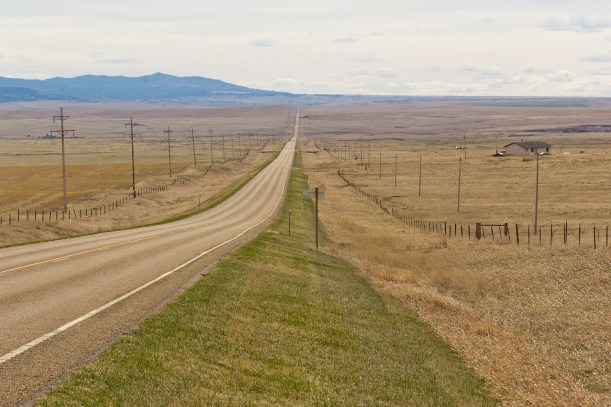
road east from agency

Highway leading east of the reservation, the start of our road trip

I don’t think of these things often any more.  They came back to me today when I began reading again a book my father gave me on that trip: Son of the Morning Star, by Evan S. Connell.  I was lead back to that book by way of an aimless succession of books about American Indians.  Memories of my father came back with it.

So tonight I toast my father with the best whisky I have on hand (though I also never understood his fondness for cheap blended Scotch) and with a sadness that caught me by surprise.  We lost each other once, then met again.  Through a long meandering drive through the high plains of Montana and the western mountains, we discovered that we were different men than we had ever known.  And we learned again that we loved each other.
 

I Just Found Out I’m A Terrorist

When a Muslim commits a terrorist act, killing innocent people, a chorus of voices quickly arises to admonish us that most Muslims (“the vast majority” is the preferred phrase) are peaceful and oppose murder in the name of their religion.  The dereliction of one or a few believers should not cause us to cast blame on all Muslims.

Those same voices speak the same message when, for example, an illegal immigrant murders.  Don’t blame all illegal immigrants, they say; most are peaceful and law-abiding and want only to contribute to society.

I agree without reservation.  This is the only fair and just attitude for reasonable people to take.  An entire group should not be condemned or blamed when one of its members commits a crime, no matter how horrible that crime is.  Evil exists among us, but no group of people should be unfairly libeled or defined by the actions of one of its own who gives in to evil, against the wishes and temperaments of the others.

But this just and enlightened concession is not granted to one large group of people: the National Rifle Association.  Instead, after every mass shooting, the NRA, in toto, is quickly and angrily blamed and condemned, even when the murderer was not a member of the NRA (and none have been), and when the NRA itself condemns the act.

In just the last few months, following the school shootings in Florida and Texas, prominent voices on television news and talk shows, in newspapers, on social media and the Internet, have called us terrorists (that’s their favorite slander), Nazis, child murderers, racists, enemies and other epithets; a few of the most extreme even call for killing us.  We are cursed and reviled at public marches and demonstrations.

It takes only minutes of searching the Internet to find examples of this, so numerous that I was overwhelmed by them.  I selected a small sample for the video that I created to provide evidence of what I claim.

Never mind that the murderers were not one of us; they were teenagers who the NRA argues should not have had guns (Cruz in Florida should have been – could have been – restricted for mental problems; the school, sheriff’s department and the FBI had evidence and cause to stop him from passing a NICS background check, but they did not do so).  Never mind that our hearts break, too, when such tragedies happen.  Never mind that we desire just as much to find ways to stop such evil from happening again, even if our solutions differ from those who hate us.

Six million innocent people (a group almost twice as large as the Muslim population of the U.S.) who band together to advocate for a constitutional civil right for law-abiding citizens, are nonetheless cast as the first and foremost villain.  If the hate and anger were not so vehement, it would almost be funny: me, a rather quiet, middle-aged man with not a single crime to my name, possessing more cats than guns and who picks up June bugs off the driveway so they don’t get crushed, an ardent civil libertarian whose childhood heroes were Dr. Martin Luther King and Abraham Lincoln….I am a racist, Nazi terrorist!

But it isn’t funny.  Nor is it just or fair or decent.  It is an angry, irrational mob frenzy of hatred directed at millions of innocent Americans who do not deserve it.  It is, quite simply, discrimination.  Perhaps most importantly, it is foolishly counter-productive.  Call us such names often enough, and even the quiet, middle-aged NRA members like myself will finally be so offended by such slander that we will see little reason for cooperation and compromise.

We may be at that point already.

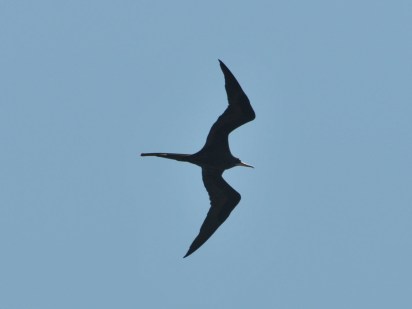
The Hurricane Bird

On the winds of our first Gulf storm of the season arrived the Hurricane Bird.  I spotted six of them soaring high over my house at dawn.  Word spread quickly along the shore; before 0800 neighbors Chris and Jessica texted to say they had counted 18.

We haven’t seen them since August of last year, when they arrived with another storm, hurricane Harvey.  We’ve seen them during other storms in my years on the bay – Ike, Rita, Alison – as I’m sure they’ve been seen during storms since the Karankawas first wandered to this coast.  As with those storms, they will be gone when the winds calm. They are pelagic by nature, and the open sea draws them away.

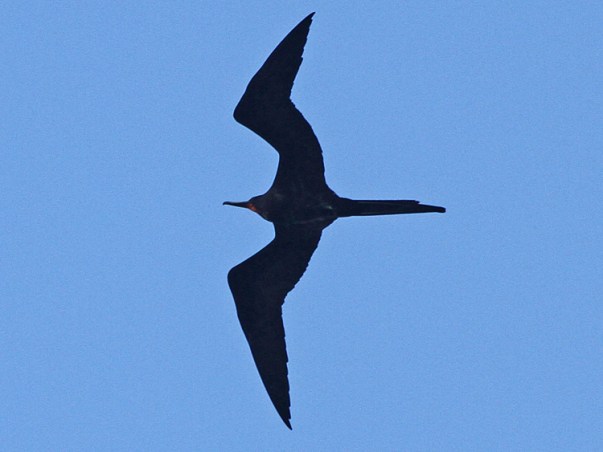
Hurricane Bird is just a nickname, known today mostly only by old-timers like me.  Their true name – and no bird more deserves such a grand name – is Magnificent Frigatebird.

Frigate, because they “can take food directly from the bill of another bird in an aerial battle. Because of their swift, soaring flight and marauding behavior, Magnificent Frigatebirds were named after British frigate warships.”

Magnificent, because…well, because they simply are.

frigatebird

If you’ve seen one, you understand.  They are so beautiful and distinctive that the Texas Pelagics birding group, which for all other species identifies other birds with similar characteristics, says they have, in effect, no equal: “Similar Species: With long sharp-angled black wings and long forked tail, Magnificent Frigatebird is unmistakable.”

Houston Audubon makes similar praise: “the Magnificent Frigatebird is instantly recognizable even at long distances. The bird has a 7.5 foot wingspan; relative to its body weight, the Magnificent Frigatebird has the largest wing surface area of any bird alive.”

They are masterpieces of flight.  They can glide and soar for up to two months without setting down; rise to a height of 2.5 miles; glide for 35 miles without beating a wing.  They sleep on the wing, sometimes for periods as brief as ten seconds and always while they are rising to gain altitude.

Pelagic they certainly are, but they are not birds of the water.  For a creature that spends most of its life over the open ocean, water can kill them.  Their feathers are not waterproof.  They fly almost without cease because “they couldn’t take a break even if they wanted to; unlike most other seabirds, frigatebirds can’t swim, becoming waterlogged and eventually drowning if they do encounter water.”

They are visitors only here on Galveston Bay.  But while they are with us, they fill us shoreliners with excitement and joy.  We don’t know when they will arrive; we don’t know how long they will stay; we don’t know when they will leave.  In this, they are like grace.

But while they are here, may they find welcome and rest.  Like old friends long unseen, I hope they stick around for a while.

Magnificent Frigatebird, Key Largo, 19-Apr-13 (3) L

(There are more beautiful photos of the frigatebird, but this aspect, like a silhouette high above us, is almost the only way we ever see it, and is how we know it.)

Tribute to a grand man

Growing up, I was blessed with a great-uncle named Alan Meyer.  No relation – the surname rather gives that away.  But we called him Uncle Alan and loved him very much.  He could scarcely have been more different from my family and boyhood life: he was cosmopolitan, a graduate of Yale, a successful advertising executive in New York and Dallas, dressed with a sartorial elegance quite strange to us, and he was Jewish.

He was the life-long companion – ‘significant other’ we would say today – of my blood great-uncle, Harry Sivia, brother of my paternal grandmother, and a fine man in his own right.

To my parents’ credit, they were the first to welcome uncles Alan and Harry into our extended family, in the early 1960s, as a same-sex couple, with a warmth and sincerity fully equal to the love and hospitality they offered to everyone else.  To my brothers and I, Alan was no less a part of our family than anyone else who sat at our holiday meal tables and drank whisky and told tales with the other Selden men on the porch on pleasant evenings.

Jewish?  Gay?  We little understood what those meant, and cared even less.  Uncle Alan was our ideal of a gentleman (we loved Harry, too, but brilliant though he was, he was a curmudgeon).  I can only wish to possess half the wit, innate kindness and grace of my uncle Alan.

Today I  finally got around to examining a few of Alan’s personal effects that were left to me after his death.  I found a small book of poems that he and a friend published in April, 1945, while Alan was still serving in the U.S. Army.  He never spoke of the book, and no one in my family knew of it or that he had written poems in his youth.

In his honor, I’ll share of few of the poems here.  The first poem in the book helps me understand how this most gentle man could choose to serve in a violent conflict.  Like the rest of the family which adopted him and loved him as one of us, he was dedicated to “the neverdying struggle to be free.”

THE CAUSE FOR WHICH WE FIGHT

(To My Parents)

If it come to that and in the service                                                                                                Of the cause for which we fight I shall indeed                                                                             Be called to sacrifice my life,                                                                                                              I pray That you will hear these things:

I realize my gift cannot compare                                                                                                    To yours who gave an only son you loved                                                                        (However little merited that love).                                                                                                My gift was negative – I ceased to be,                                                                                          And by that action made my life a whole;                                                                                    But yours was positive: you lost what was.

I loved and honored you above all else,                                                                                      And yet I have not honored you enough,                                                                                  Who built me, made me fit to serve – and loved.                                                                      This do I know, and this do I regret –                                                                                            But anguish nor remorse remake the past!

Know you that fact; I’m gone and that is all;                                                                                Be proud you gave whom country could employ                                                                            In her behalf when she had need of men.                                                                                     Of this you may be sure:                                                                                                                     I served my country and my countrymen –                                                                                 And well I served the cause for which we fight:                                                                           The neverdying struggle to be free.

(AHM, Ft. Monmouth, N.J., Feb., 1943)

Huck Finn Days

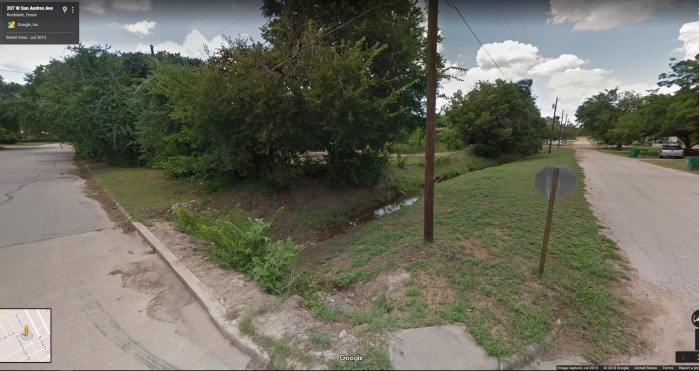
Look closely at this photo.  There is nothing remarkable about it, is there?  A tree or two, unkempt streets, and a tiny stream so marginal that it seems to scarcely exist.

Ham Branch

Poor and unremarkable as it may be, that is the place where I spent countless happy hours of my boyhood, in Rockdale, Texas.  It was a favorite summer destination for my brothers and pals.  Our bikes took us there – and many other places in town and miles into the country – carrying nothing more than cotton twine, slices of bologna and a coffee can, sometimes a book.  With pieces of bologna tied to the twine, we coaxed crawdads to the surface, where we scooped them up with the coffee can.  (We took them home and dumped them in the hand-made goldfish pond our mother and we had spent weeks building, muddying it up considerably.)  Nothing else lived in or around that still, muddy water, except a few snakes and lizards; unless a rain had fallen recently, the little creek didn’t even flow.

Sometimes we stomped around in the water and mud; sometimes we lay under the tree – the one in the photo is probably the same one that shaded us – and read books which always featured cowboys, football heroes, bold adventurers.  Sometimes we walked a few blocks north to the old minnow farm, to watch the shimmering mass of fish in numbers we couldn’t imagine.  We spent entire days there, being free to roam the summer hours under only one command: pedal home by dark.

This tiny stream has a name: Ham Branch.  Brother Rush sent the photo to me today.  Searching it, I can’t see a single thing that has changed in 50 years.  How can such a meager, unadorned place pull so mightily on my heart?  It is a place most people would pass without thought or notice.

Now imagine how simple and innocent is the life of a child who chooses that place as a favorite spot to spend summer days.  Muddy, dirty water (often stagnant in summer), weeds and snakes (real or imagined), crawdads….but we looked forward to hopping on our bikes and riding there to hang out for hours, with nothing more than a single shade tree, string and bologna and a coffee can, a book or two, and imaginations.

I wouldn’t trade it for all the rides in Disneyland…

Test Your Cat Mojo Here

For those of you who consider yourself true ailurophiles, here is a simple quiz to gauge your knowledge of cats.

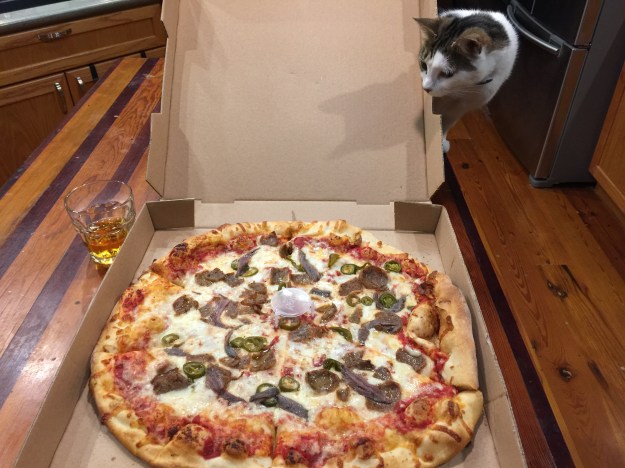
Q: In this photo, what is Gummy Bear (the peeping calico) most interested in?

  1. pizza cheese
  2. those salty little anchovy fish
  3. the single-malt Scotch

IMG_5129

A: None of the above, of course.  Like cats everywhere, she’s waiting for an empty box to play with.


Pelican Days

The bay is alive and shimmering with shore birds, most especially brown pelicans.  Morning and evening I see them fishing, roosting on piers and gliding past the house and shore.  This morning a flock of them were feeding on a school of bait fish very close in to shore, right next to my house.

Each evening they migrate from north to south along the shore.  From late afternoon until dusk they glide by in ones, twos or groups of a dozen or more.  I don’t know where they go, but in those few hours hundreds must pass by.  Most of them fly near our houses, just above the shore; we believe the air currents must be best there.  I shot this not an hour ago:

For My Friend, Stuart…Thank you

I write the following because my friend and piping buddy, Stuart, got me thinking about my position regarding gun ownership rights.  (In your honor, Stuart, I began writing this while listening to the Old Blind Dogs and sipping a fine 15-year-old Glendronach…all the while surrounded by the six finest cats in all of Seabrook.  And stay tuned…there will be a part 2.)

In reply to my overly sardonic blog post about my latest rifle purchase and the Florida school murders, Stuart wrote:

“I’m more or less on the other side of this argument, but at least I know this unnecessary abomination is in safe hands.”

This may seem like an unremarkable thing to say, but I was struck by Stuart’s kindness and decency.  These are times when to be an unrepentant gun owner and NRA member is to face scorn and undeserved accusations almost daily.  We are regularly condemned as terrorists, Nazis, child-murderers, racists and other slurs, by people at the highest levels of politics, journalism, entertainment, and even public school students.

It is easy to shrug off a few such accusations – I understand the frustration and despair following tragedies such as the recent school murders in Florida and here in Texas.  But they sting.  Hear them often enough – and I and my NRA colleagues do hear them often – and all understanding and sympathy are worn down, to be replaced with resentment and defiance. To someone who despises the evils we are accused of, and who opposes them on deep principle, to be accused of such vile beliefs goes far beyond tolerable derision and unfairness.

So I am grateful for Stuart’s acknowledgement that my guns are “in safe hands;” he knows that I could never commit evil with or without them.  I don’t know how many gun owners and NRA members Stuart knows, but he knows one: me.  I am not an abstraction or a stereotype to Stuart; I am not a gun boogeyman.  He knows me; and knowing me, he knows that I am none of the things that I and other gun advocates are accused of being.  He may condemn the gun, but he does not condemn me for owning it.

So, a hearty ‘sláinte’ to you, Stu.  I only wish those with voices louder than yours were so reasonable.