Monthly Archives: July 2018

Uninfringed in Texas

Yosemite stole my heart many years ago – I’ve climbed its mountains and hiked at least a  hundred miles of its trails – and the central coast enchants me, but when it comes to personal liberties – the political and social quality I cherish above all others – I am most at home in Texas and the freedom states of the west (Arizona, Utah, Wyoming, Montana).  To live anywhere where those liberties are constrained, would chafe me too severely to be happy.

A fine example: while browsing at for a fishing shirt at Marburger’s, Old Seabrook’s sweet little sporting goods store, I came across a Springfield XD-9 on sale.  I’ve been resisting the urge to replace my too-small carry pistol, a Ruger LC9, with something with a longer barrel and double-stack magazine (the LC9 is only a 7-round single-stack).  My budget didn’t call for splurging for another gun, but the price was right; the Marburger folks greeted me as a homeboy they know well; and I am a strong advocate for supporting local, independent businesses.

A CHL and background check later, I walked out of there with a lovely new pistol. On the case was this tag: “Not Legal In California and W/High Capacity Magazine.”  Thank God for Texas – and in your eye, California!

IMG_5422

Light and comfortable on the hip:

IMG_5415

Strange Voice in the Night

One cannot live on this bay for 23 years, with eyes open, and not feel awed by the unrestrained flourish and fecundity of birds.  In my small world, they furnish the motion and sound that dominate each day.  In other words…life.

I have made a hobby of knowing them.  I watch them, study them, listen to them.  A shelf in my house holds nothing but books about birds, all well used.  I know our birds by sight, by silhouette, by flight pattern, by time and place, by behavior, by song.  I know our residents, and I know those who only visit or migrate here to spend winters.  I treasure each species, each bird, and each time I learn something new about them I treasure them more.  In my relations with birds, familiarity breeds affection, and I know and love them well.

But they can still humble me.  Just tonight, as I stepped out to the deck to sip a bit of Scotch and to watch lightning far to the east, I heard a bird I have not heard before.  A single, clear, brief note, falling and echoing faintly at its end, sounded above the shore.  It continued again and again, so that I could hear the bird rising in the air over the bay, then dropping and moving over my yard before soaring again over the water.

I was entranced.  This was a bird call like no other I’ve heard before.  The night is very dark, no moon lightening a sky shrouded by storm clouds.  I got no glimpse of the bird itself.

What was it?  I have no idea.  Perhaps I never will.  I haven’t heard it before in all these years; perhaps I’ll never hear it again.  It will trouble and perplex me – I really want to know this new bird that courses through my world so late at night.

I’ll have to live instead with an intriguing mystery.

Goodbye Old Friends

In November, 2000, a month after moving here, I planted two Canary Island date palms in the bare space between the house and the bay.  Less than two feet tall at the time, they had grown from seeds I collected from the best trees I could find.  I selected these two from a few dozen I tended in pots in the garage.  They were to be the tropical showcase of the bay-front yard.

I took great care with them, and they flourished.  They grow slowly, as is their nature, but within a few years they were displaying all the traits I admire in the Canary: sturdy trunks; long arcing leaves; a broad canopy unequaled among palms.  They shaded my cats and me through summer afternoons, and sheltered birds innumerable, especially the flocks of monk parakeets that seem born to pair with such a tree.

Over these 18 years they have endured the extremes of weather the Texas coast is known for: fierce storms, heat and drought, even the rare freeze and ice.  Returning after hurricane Ike in 2008 I found my house and all that I owned wiped from the face of the earth, but the date palms stood; though a bit worse for wear, they survived that storm’s 17-foot storm surge and 110 mile-per-hour winds.  Through storms and calm, I marveled at how they can be both durable and delicate.

But they won’t survive a bacteria so rudimentary that it has no cell wall and cannot be cultured. The Texas Phoenix Palm Decline phytoplasma, tiny as it is, will do what even the ferocity of Ike could not do: kill my old friends.

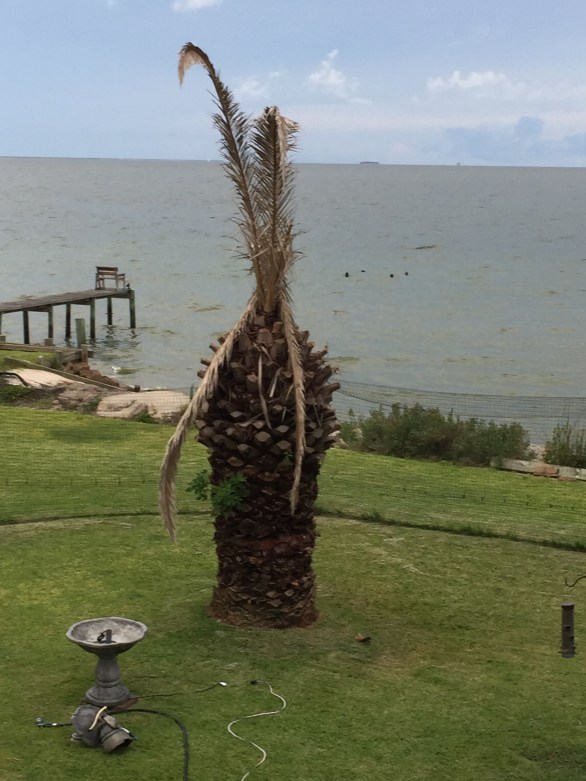
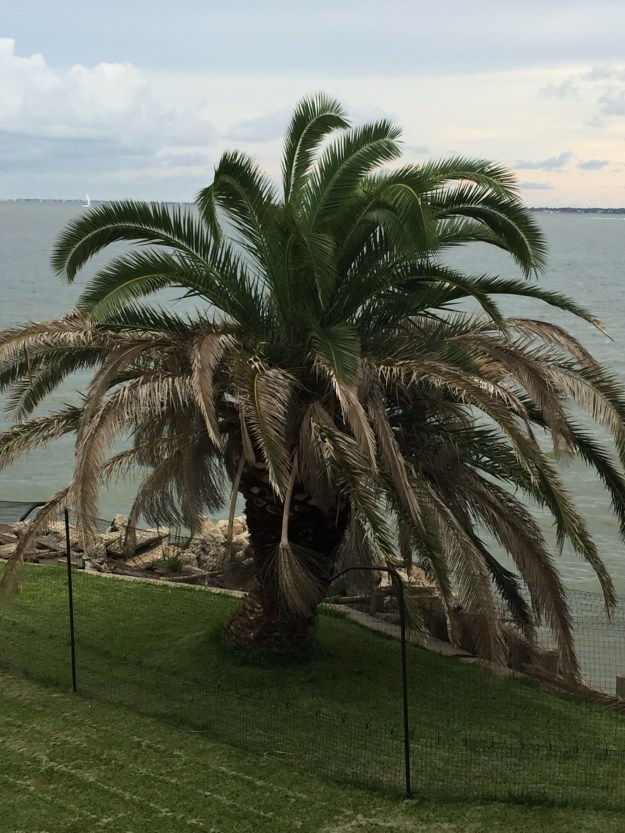
The largest is dead now.  As is typical with TPPD, its lowest leaves browned and died; those above soon followed.  Nothing green remains on it now, only a handful of dead leaves I haven’t yet removed.  The other palm still displays a crown of new green leaves, but its lower leaves are browning and dying, showing the certain early stages that will take the tree before summer is gone.

It breaks my heart to see them now.  Yes, they are only trees.  But their roots were put down here when mine were.  Their tropical grace has framed my view of the bay through changing light and seasons, through countless rises of sun and moon, through bay storms and blue skies.  They have cheered and soothed me through my own storms and frosts.

I cannot imagine this place without them.  When they are gone, they will leave empty places in the landscape, and in my heart.

IMG_5393

The largest, now dead

IMG_5395

The smaller, showing TPPD symptoms